
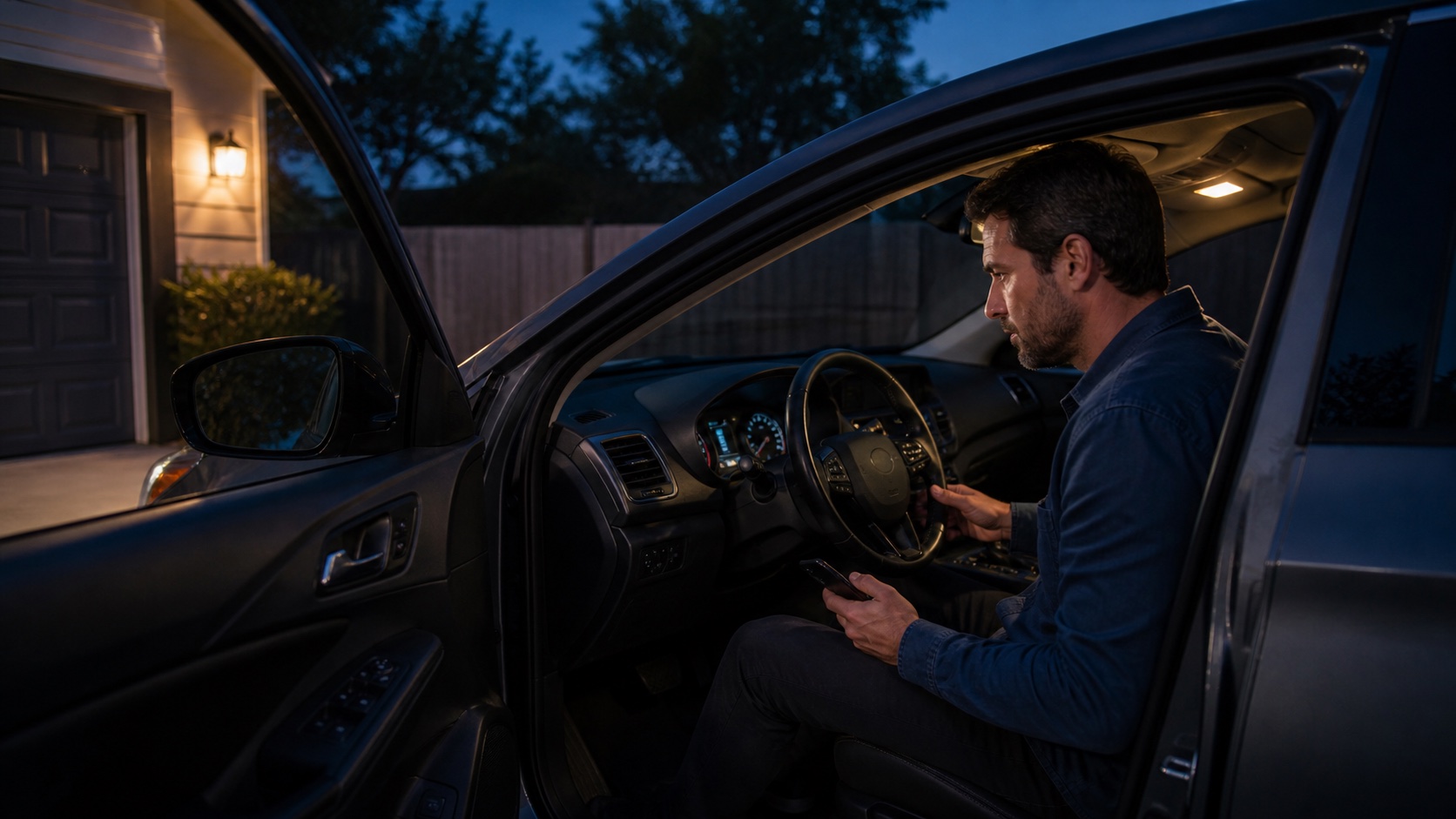
Normal pedal feel does not prove ABS is working or the car is safe. Check for a red brake warning or changed braking first, then read the exact ABS module.
Connect it to ScanWrench and see what your car actually returned.
Start with the other warnings and the brake pedal
An ABS lamp can illuminate briefly during a normal startup check. A lamp that stays on or appears while driving is different: read the exact owner's-manual instruction for that vehicle and arrange a prompt inspection.
If a red brake-system warning is also on, the brake pedal feels soft, hard, or unusually low, stopping distance or direction changes, brake fluid is visibly leaking, or you hear grinding, stop in a safe place. Do not keep driving to see whether the warning clears. Follow the vehicle manufacturer's emergency guidance or obtain qualified assistance.
If the amber ABS warning is the only light and the brakes feel unchanged, do not turn that into an all-clear. The safest next step still depends on the exact vehicle and fault, and the owner's manual controls the immediate response.
Why ordinary braking can still feel normal
ABS is a control layer within the service-brake system. It monitors wheel behavior and modulates braking when a wheel is approaching lockup. A gentle stop on dry pavement may never call on that function, so the pedal can feel familiar even when the controller has detected a problem.
Some faults leave base braking available while limiting or disabling anti-lock assistance; other faults can involve related brake-assist or distribution functions. The lamp alone cannot tell you which capability remains. Do not perform a hard stop on a public road to test it.
ABS, traction-control, or stability-control warnings may appear together on some vehicles. That combination is useful evidence about what the vehicle reported, but it does not identify one failed sensor or authorize a parts purchase.
- Observed fact: the ABS warning stayed on or appeared while driving.
- Plausible paths: an input, electrical path, controller, or related brake function did not pass its check.
- Still unknown: the exact fault, remaining braking capability, and whether related systems were checked.
- Next proving test: read the exact ABS module and follow vehicle-specific service information.
Why a generic engine scan may show no code
The standardized OBD path used for a check-engine light is built around regulated emissions and powertrain evidence. ABS is normally a chassis or manufacturer-controlled module. A generic scan can therefore return zero engine codes while the ABS controller retains its own fault record.
Only call ABS checked when a compatible tool completed a read from the exact ABS module for the exact vehicle and preserved the module, operation, profile, adapter, and time. A successful generic powertrain scan does not inherit upward into ABS coverage.
Keep airbag/SRS and stability control separate too. Reading one safety-related module does not prove the others were contacted, and an empty fault list is not a brake inspection or safety certificate.
Preserve the warning before anyone clears it
While safely parked, record which warning lights are on, the mileage, when the event began, weather and road conditions, any change in pedal feel or stopping, and recent battery, tire, wheel-bearing, or brake work. Those facts help the next technician separate timing from coincidence.
Do not clear codes or disconnect the battery merely to make the lamp disappear. A clear command changes the evidence; it does not repair the condition or prove that anti-lock operation returned.
If an exact ABS read is supported, save every returned code with its status and module identity. If the module could not be reached, label the attempt failed or unsupported. Never convert no response into no problem.
The next test should reduce uncertainty
Use the exact vehicle's current service information or a qualified repair facility to read the ABS module, inspect the physical brake system, and perform the manufacturer's diagnostic sequence. The first test should separate likely branches rather than replace the first part named in a search result.
For U.S. vehicles, also check the VIN in NHTSA's recall database. An open recall can identify an official remedy, but a recall lookup by itself does not diagnose the warning on the vehicle in front of you.
After repair, require more than a dark lamp. Preserve the follow-up module read and the qualified functional check required by the manufacturer. A warning that turned off is one observation—not proof of every braking function.
Can I drive with the ABS light on?
There is no universal yes-or-no answer. If a red brake warning is also on or braking has changed, stop safely and follow the owner's manual or obtain qualified help. If the amber ABS light is alone and braking feels unchanged, consult the manual and arrange prompt inspection rather than assuming the system is safe.
Will a regular OBD-II scanner read ABS codes?
Not necessarily. Generic OBD focuses on standardized emissions and powertrain evidence. ABS normally requires exact manufacturer-enhanced module access supported by the vehicle, adapter, transport, definitions, and software profile.
Can low battery voltage turn on the ABS light?
Low voltage or an interrupted electrical path can be a plausible contributor on some vehicles, but the lamp does not prove that cause. Preserve voltage and timing evidence, read the exact ABS module, and follow vehicle-specific testing before replacing a battery or ABS part.
Does the ABS light mean the brakes will fail?
Not by itself. Some faults leave base braking available while anti-lock assistance is limited, but the exact remaining capability depends on the vehicle and failure. A red brake warning or any change in braking requires immediate attention under the owner's manual.
THE TAKEAWAYTreat the ABS light as a system warning, not a parts verdict. Screen for urgent brake symptoms, preserve the exact evidence, and require an ABS-module read before anyone calls the system checked.
A clean engine scan does not clear the ABS light.
Verify whether your exact vehicle, adapter, and ScanWrench setup can read the ABS module. Unsupported systems stay labeled not checked.
ScanWrench Editorial created this issue from the platform's evidence model and current primary sources. It separates observed facts, plausible paths, decisive tests, safety limits, and remaining unknowns. Its purpose is to improve vehicle decisions; it does not replace exact manufacturer procedures or qualified professional judgment.
See how this page earns trust.
These links are primary-source starting points for the page's scope. They do not replace the current manufacturer procedure, wiring, specification, or service information for a specific vehicle.
Publisher
ScanWrench Editorial is the working byline for this library. Joshua Black, founder and publisher, is responsible for publication decisions, disclosures, and corrections.
A reviewed date means an editorial scope and safety check. It is not an ASE credential, OEM authorization, or vehicle-specific repair approval.
Primary sources
- 49 CFR 571.135 — Light vehicle brake systemsElectronic Code of Federal Regulations · Current federal definitions and indicator requirements for service brakes, ABS, functional failures, and separate yellow ABS warnings.
- Dashboard symbols and warning lightsToyota Motor Sales, U.S.A. · Current manufacturer owner guidance distinguishing ABS, brake, SRS, slip, and VSC indicators; Toyota guidance is not presented as universal vehicle behavior.
- On-Board Diagnostic regulations and requirements: questions and answersU.S. Environmental Protection Agency · Official boundary around standardized emissions-related OBD monitoring and manufacturer-controlled diagnostic information.
- Vehicle safety recallsNational Highway Traffic Safety Administration · Official VIN-level U.S. safety-recall lookup and recall guidance.
Revision history
- Initial publication and review: claim boundaries, safety language, internal links, and cited source scope checked.
No material correction is hidden. Material additions and corrections are dated above when they occur.
Report a possible correction ↗