
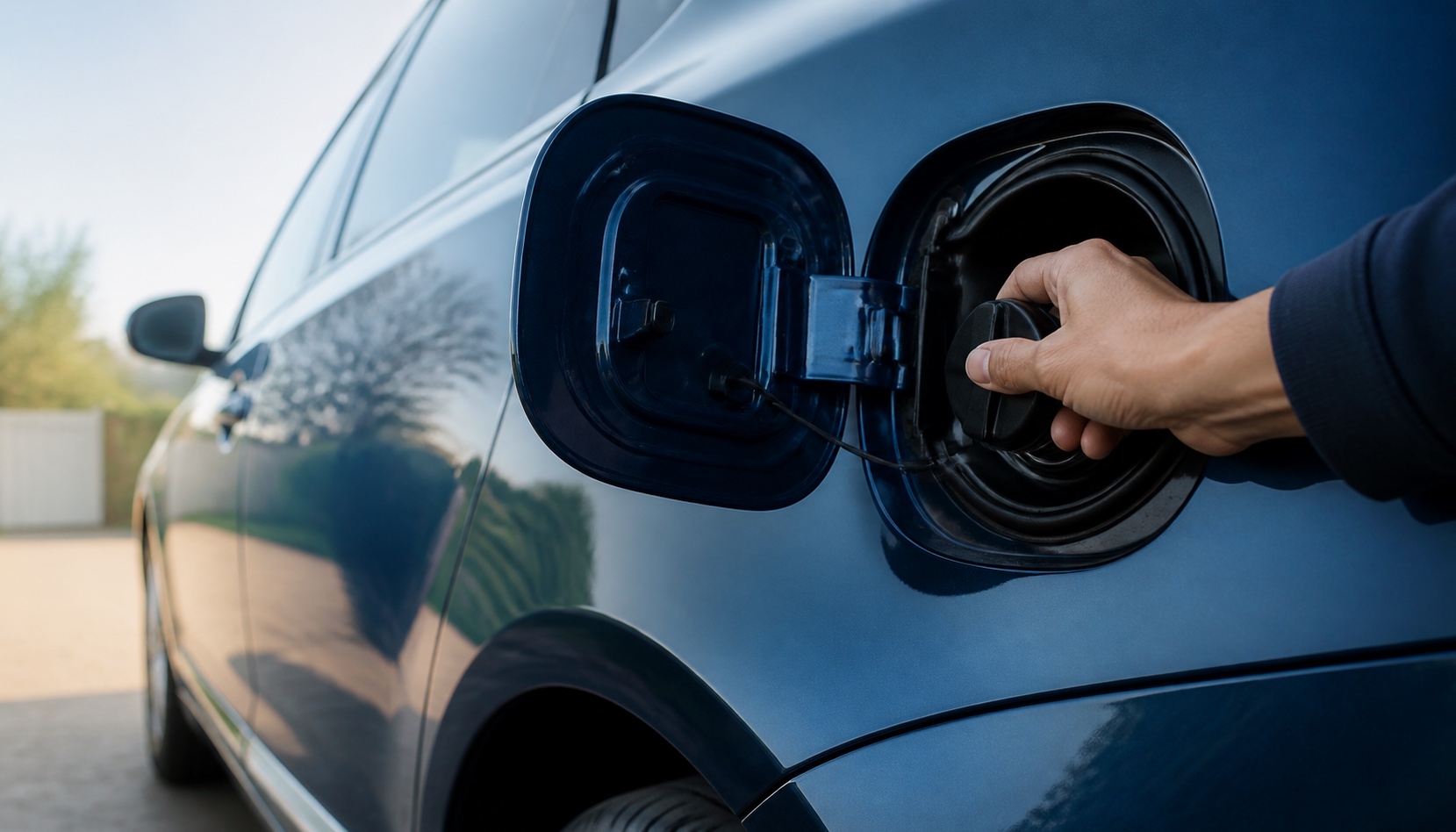
Yes. A loose or damaged gas cap can trigger an EVAP-related check-engine light—but tightening it does not prove the fault is fixed or the car is inspection-ready.
Connect it to ScanWrench and see what your car actually returned.
Start with the cap, not a parts order
Park safely, switch the engine off, and follow the owner’s manual for opening and closing the fuel cap. Check that the cap is present, seated correctly, and free from obvious seal damage, contamination, or tether interference. Tighten it using the vehicle’s specified method; many caps click, but the exact design varies.
Do not replace the cap solely because a generic code description contains the words small leak or large leak. A scan reports what the controller detected. It usually does not identify the exact physical leak source.
If the light is flashing, or the vehicle is running poorly, shaking, losing power, overheating, or showing another urgent warning, do not reduce the event to a gas-cap theory. Minimize driving and follow the vehicle manufacturer’s safety guidance or obtain qualified assistance.
Why the light may stay on after you tighten it
The vehicle does not necessarily rerun its evaporative leak test immediately. EVAP monitors can require specific enabling conditions involving fuel level, temperature, soak time, speed, load, and other manufacturer-controlled criteria. There is no universal number of miles that guarantees completion.
After the cap is secured, the vehicle may need several qualifying trips before it decides that the fault condition is gone and turns the light off. If the condition remains, the light can stay on or return.
Avoid clearing codes merely to turn the light off. Clearing can erase useful freeze-frame context and reset readiness monitors, making the vehicle less ready for an emissions inspection while hiding evidence needed for diagnosis.
What a scan can—and cannot—tell you
A disciplined generic OBD scan can record malfunction-indicator status, stored, pending, and permanent emissions codes, available freeze-frame data, supported readiness monitors, the EVAP monitor state, and the scan context. It cannot see the physical leak or prove which part caused it.
Common standardized EVAP-family codes include system, leak, purge, and vent faults, but a code’s presence still does not prove the cap caused it. Manufacturer-controlled codes and definitions require exact, lawful application information.
The strongest comparison is a saved before-and-after record. Preserve the original scan, secure or service the cap as appropriate, allow the vehicle to rerun its own monitor during normal permitted operation, then compare code states and readiness evidence. Do not force a drive cycle that conflicts with traffic law, weather, vehicle condition, or manufacturer instructions.
- Observed fact: the cap was loose, missing, damaged, or poorly seated.
- Plausible cause: the cap allowed the EVAP system to detect a qualifying leak.
- Still unknown: whether the cap is the only fault in the sealed system.
- Next proving test: a completed onboard monitor plus an exact leak test if the evidence remains.
Can a loose cap make a vehicle fail an emissions test?
It can contribute to a failed inspection, but the result depends on the vehicle and the current rules where it is registered. Official OBD programs can consider the check-engine light, commanded MIL status, stored emissions faults, readiness, communication, and sometimes a separate cap check. The official inspection authority—not ScanWrench—determines pass or fail.
A light that turns off after the cap is secured is useful evidence that the vehicle no longer sees the same qualifying fault. It is not an inspection guarantee. Readiness may still be incomplete, a permanent code may remain, or a separate physical cap check may find a problem the onboard monitor did not identify.
Before an inspection visit, scan the car without clearing anything. Record whether the MIL is commanded on, which code channels contain evidence, and whether the supported monitors required by the local program have completed. Then check the current official rules for the registration jurisdiction.
The practical next step
If the cap was visibly loose, secure it correctly and preserve that observation. Scan now, keep the original evidence, and let the vehicle’s own monitoring logic determine whether the condition is resolved.
If the light remains on, returns, or the scan points beyond a simple cap-seating issue, use the exact vehicle’s service information or a qualified repair facility to test the EVAP system rather than guessing at parts.
How long does it take for the check-engine light to turn off after tightening the gas cap?
There is no universal mileage or trip count. The vehicle must rerun the relevant self-test under its own enabling conditions and decide that the fault is no longer present. Several qualifying trips may be required.
Should I clear the code after tightening the gas cap?
Usually, preserve and diagnose the evidence before clearing. A clear command can erase freeze-frame context and reset emissions readiness. Clearing the light does not prove that the leak is fixed.
Which codes can a loose gas cap cause?
A cap problem can contribute to EVAP-system leak evidence, but the code alone does not identify the cap as the cause. Capture the exact code, status, freeze frame, and readiness state, then follow vehicle-specific diagnostic information.
Can I pass an emissions test after the light turns off?
Possibly, but the light being off is not the whole inspection. Readiness, stored or permanent evidence, communication, physical checks, vehicle eligibility, and jurisdiction rules can also matter. Only the official program determines the result.
THE TAKEAWAYCheck the cap, preserve the scan, and let the vehicle’s own monitor provide the next evidence. Do not turn one plausible cause into a repair or inspection guarantee.
Turn the warning into a saved record.
Capture the standardized evidence your exact vehicle and compatible adapter return.
ScanWrench Editorial created this issue from the platform's evidence model and current primary sources. It separates observed facts, plausible paths, decisive tests, safety limits, and remaining unknowns. Its purpose is to improve vehicle decisions; it does not replace exact manufacturer procedures or qualified professional judgment.
See how this page earns trust.
These links are primary-source starting points for the page's scope. They do not replace the current manufacturer procedure, wiring, specification, or service information for a specific vehicle.
Publisher
ScanWrench Editorial is the working byline for this library. Joshua Black, founder and publisher, is responsible for publication decisions, disclosures, and corrections.
A reviewed date means an editorial scope and safety check. It is not an ASE credential, OEM authorization, or vehicle-specific repair approval.
Primary sources
- Do You Drive a 1996 or Newer Car or Light Truck?U.S. Environmental Protection Agency · Official owner guidance for a steady or blinking malfunction indicator light, including a loose or missing fuel-cap check.
- On-board Diagnostics Frequently Asked QuestionsOregon Department of Environmental Quality · Official fuel-cap, self-test, readiness, and OBD inspection guidance; Oregon requirements are not presented as universal rules.
- MOVES5 Evaporative Emissions from Onroad VehiclesU.S. Environmental Protection Agency · Current EPA technical treatment of EVAP OBD fault evidence and the distinction between onboard checks and separate fuel-cap testing.
- OBD frequently asked questionsU.S. Environmental Protection Agency · Public explanation of regulated emissions diagnostics and the malfunction indicator light.
Revision history
- Initial publication and review: claim boundaries, safety language, internal links, and cited source scope checked.
No material correction is hidden. Material additions and corrections are dated above when they occur.
Report a possible correction ↗