
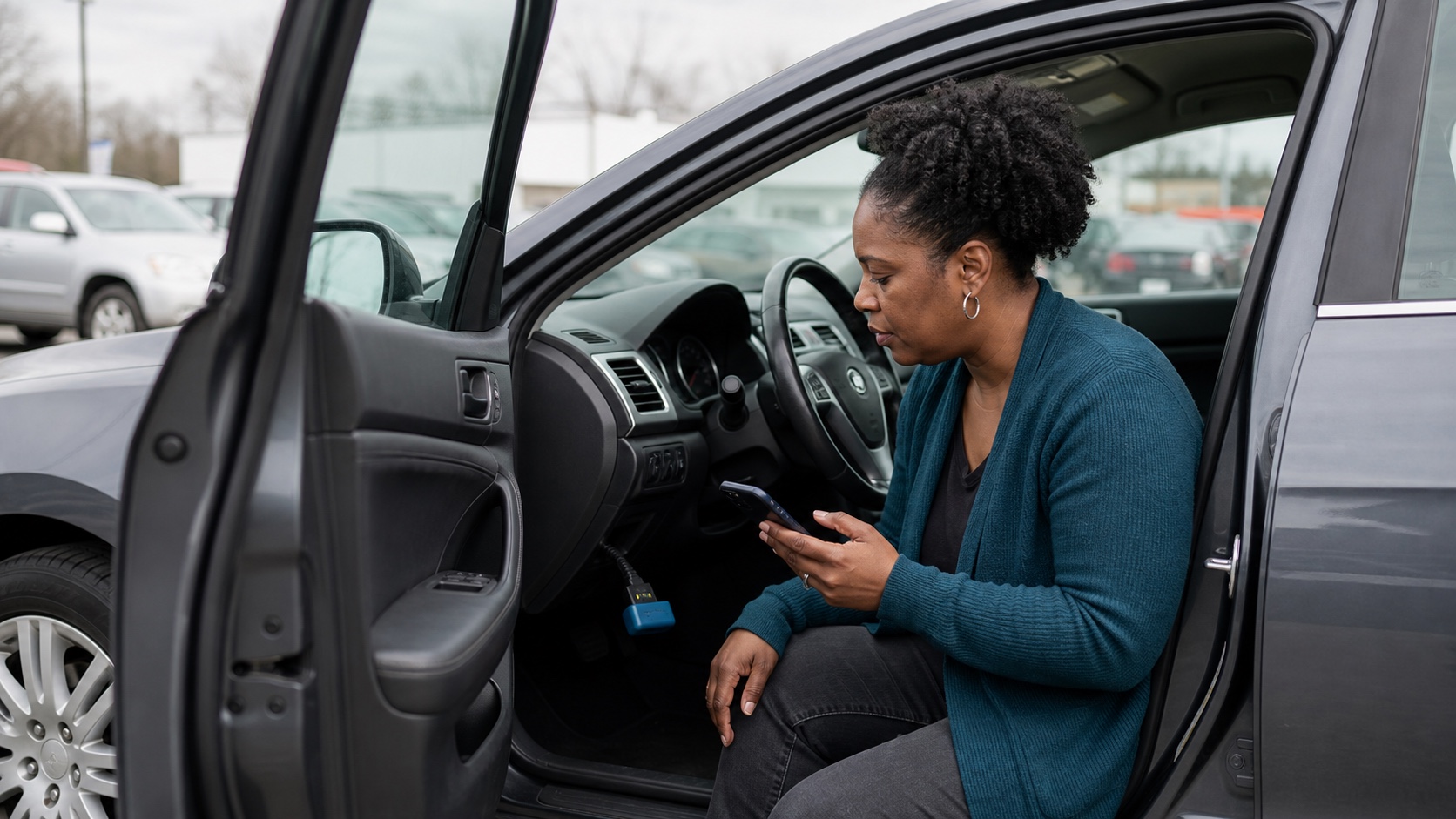
Sometimes the scan leaves clues, but it cannot prove who cleared the codes or why. Check readiness, permanent codes, MIL status, and scan completeness before buying.
Connect it to ScanWrench and see what your car actually returned.
The scan can show a reset pattern—not who caused it
Readiness monitors record whether supported emissions self-tests have completed since diagnostic memory was reset. If several supported monitors are incomplete while the dashboard light is off and no stored emissions codes are returned, the vehicle has not yet supplied a fully tested clean result.
That pattern is consistent with several explanations: someone cleared codes, the battery was disconnected or replaced, controller power was lost, a module was replaced, recent service reset memory, or the vehicle simply has not met the conditions needed to complete its monitors. The pattern does not identify which explanation is true.
Describe the evidence neutrally. Say that the self-tests are incomplete or that memory appears to have been reset. Do not accuse a seller, dealer, or repairer without independent proof of who acted, when, and why.
- Observed fact: the exact code channels, MIL command, and readiness states returned now.
- Plausible paths: code clearing, battery or controller power loss, service work, or unmet monitor conditions.
- Still unknown: who reset memory, why it changed, and whether a fault will return.
- Next proving test: preserve this scan, obtain service context, and compare later evidence after safe normal operation and an independent inspection.
Record the whole standardized OBD snapshot
With permission, scan before anyone clears codes or disconnects the battery. Record commanded check-engine-light status, stored and pending emissions codes, permanent codes when the vehicle supports them, every supported readiness monitor and its state, available freeze-frame data, communication result, protocol, reported VIN when available, date, and displayed mileage.
Keep supported, incomplete, unsupported, and not checked separate. An unsupported monitor is not an incomplete test. A module that the adapter never accessed is not clear. A generic OBD scan mainly covers the standardized emissions path; it does not establish that ABS, airbag/SRS, stability control, body, hybrid, or every manufacturer controller was checked.
Save the first result even when it looks quiet. A timestamped baseline lets the buyer compare what changes after a permitted cold start, road test, inspection, or later scan without rewriting the original evidence.
Permanent codes can help, but absence proves little
On vehicles that support permanent emissions DTCs, those records are designed not to disappear merely because a scan tool cleared ordinary codes or the battery was disconnected. The onboard system clears a permanent code only after it verifies the relevant fault is no longer present under its own criteria.
A permanent code can therefore preserve useful context after an ordinary clear. Its absence does not prove memory was never cleared: support varies, not every event creates a permanent code, and a vehicle may already have completed the verification needed to remove one.
Missing freeze-frame data is also not proof of tampering. Availability and code association vary. Report what the vehicle actually returned rather than treating an empty field as evidence of intent.
Use the road test to gather evidence, not force a drive cycle
There is no universal number of miles, starts, or minutes that makes every monitor complete. Enabling conditions vary by vehicle and monitor and may involve temperature, fuel level, load, speed, soak time, or a fault that prevents completion.
If the owner permits a normal road test and the vehicle is safe to operate, compare the saved pre-drive and post-drive results. A pending code, returning warning, monitor result, abnormal temperature, rough operation, charging problem, or communication change may be more informative than the first quiet screen.
Do not attempt an improvised drive cycle that conflicts with traffic law, weather, warning-light guidance, or the vehicle's condition. Use exact manufacturer information or a qualified professional when a specific completion procedure is necessary.
Pause the purchase when the evidence cannot be completed
A scan is one part of a pre-purchase decision. Pair it with an independent mechanical and structural inspection, a cold start when practical, service and title records, open-recall research, tire and brake measurements, leak and underbody checks, and application-qualified hybrid or EV testing when relevant.
If the seller will not allow an independent inspection, refuses a reasonable repeat scan, cannot explain a recent battery or repair event, or pressures you to decide while supported monitors remain broadly incomplete, treat the uncertainty as unresolved risk. That is a reason to pause—not proof of fraud.
Urgent warning lights, severe rough running, overheating, oil-pressure warnings, fuel odor, smoke, braking or steering changes, or unsafe vehicle behavior require the owner's manual and qualified help. Do not continue a road test merely to complete diagnostic evidence.
Do incomplete readiness monitors mean the seller cleared codes?
No. They show that supported emissions self-tests have not completed since memory was reset. Code clearing is one possible reason, but battery power loss, service work, controller replacement, unmet conditions, or a fault can produce the same pattern.
Can disconnecting the battery hide a check-engine code?
A battery disconnect can erase some ordinary diagnostic memory and reset readiness on many vehicles, but it is not a repair and it does not erase every kind of record. Permanent DTCs, when supported, are designed to remain until the vehicle verifies the fault is gone.
Can a permanent code reveal that codes were cleared?
It can preserve evidence after an ordinary clear, but it cannot identify who cleared memory or why. The absence of a permanent code does not prove that no clear occurred because support and setting criteria vary.
How long after codes are cleared do readiness monitors reset?
The reset happens with the clear; completion afterward has no universal mileage or time. Each supported monitor needs its own conditions, and a fault can prevent completion.
Should I buy a used car with monitors not ready?
Do not treat incomplete monitors as a clean bill of health or automatic proof of deception. Preserve the scan, ask for repair and battery context, obtain an independent inspection, and delay the decision until the missing evidence is understood.
THE TAKEAWAYA recent clear can leave clues, but no single generic scan proves who cleared memory or why. Save the exact code, MIL, readiness, and communication result; keep unscanned systems visible; and let independent inspection plus comparable evidence guide the purchase.
Save the first scan before the story changes.
With the seller's permission and a compatible adapter, ScanWrench can record standardized engine-code channels, commanded check-engine-light status, and readiness. Manufacturer-controlled systems remain not checked unless exact support is verified.
ScanWrench Editorial created this issue from the platform's evidence model and current primary sources. It separates observed facts, plausible paths, decisive tests, safety limits, and remaining unknowns. Its purpose is to improve vehicle decisions; it does not replace exact manufacturer procedures or qualified professional judgment.
See how this page earns trust.
These links are primary-source starting points for the page's scope. They do not replace the current manufacturer procedure, wiring, specification, or service information for a specific vehicle.
Publisher
ScanWrench Editorial is the working byline for this library. Joshua Black, founder and publisher, is responsible for publication decisions, disclosures, and corrections.
A reviewed date means an editorial scope and safety check. It is not an ASE credential, OEM authorization, or vehicle-specific repair approval.
Primary sources
- Performing Onboard Diagnostic System Checks as Part of a Vehicle Inspection and Maintenance ProgramU.S. Environmental Protection Agency · Official separation of physical lamp state, commanded MIL state, diagnostic codes, readiness, communication, and inspection outcomes.
- On-Board Diagnostic Test ReferenceCalifornia Bureau of Automotive Repair · Official readiness, permanent-code, communication, and inspection-test context for California.
- OBD frequently asked questionsU.S. Environmental Protection Agency · Public explanation of regulated emissions diagnostics and the malfunction indicator light.
- Vehicle safety recallsNational Highway Traffic Safety Administration · Official VIN-level U.S. safety-recall lookup and recall guidance.
Revision history
- Initial publication and review: claim boundaries, safety language, internal links, and cited source scope checked.
No material correction is hidden. Material additions and corrections are dated above when they occur.
Report a possible correction ↗