
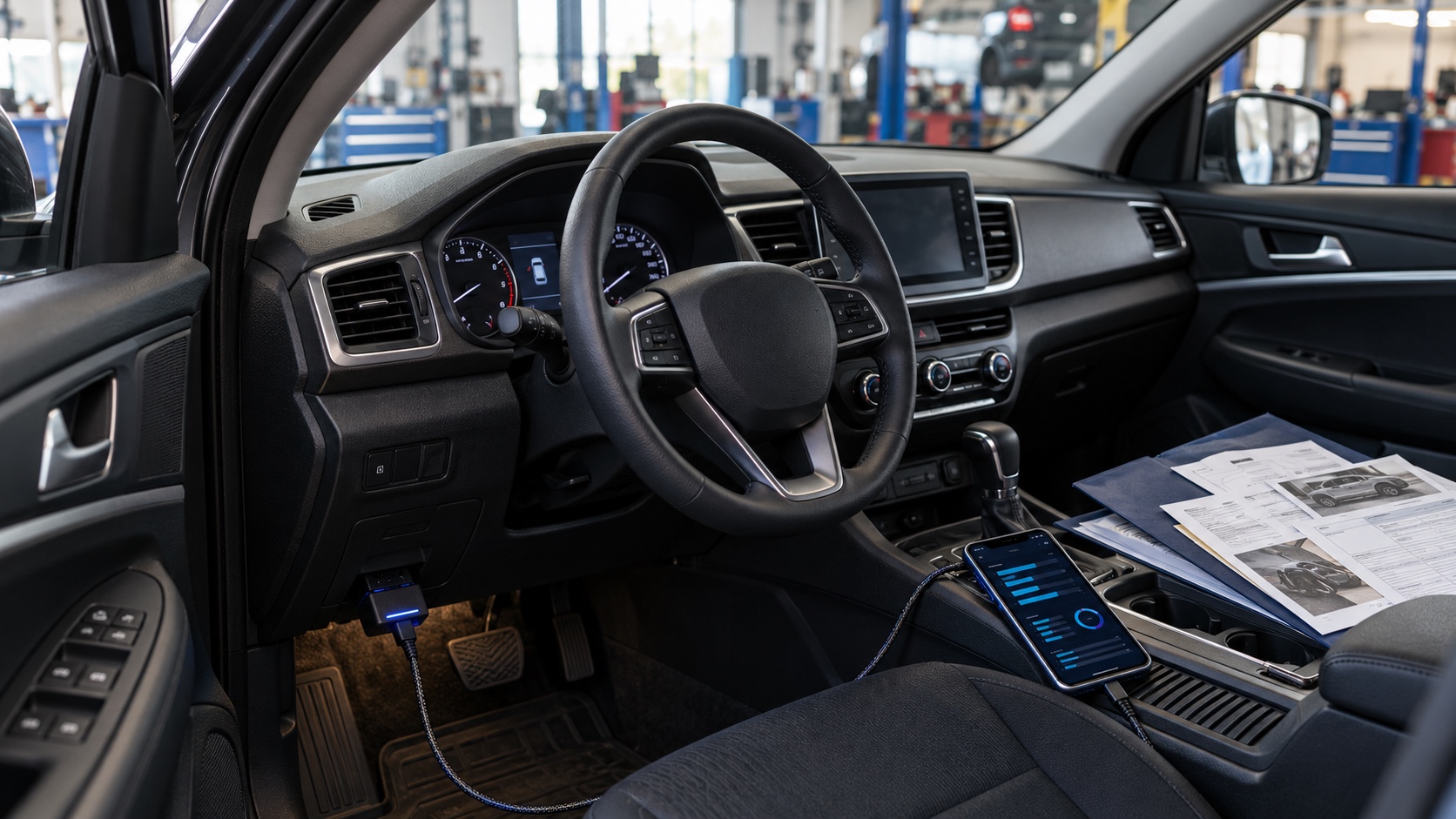
Sometimes a scan can reveal a mileage mismatch, but it cannot certify the odometer or prove fraud. Learn which records to compare before buying.
Connect it to ScanWrench and see what your car actually returned.
A scan can find a discrepancy—not certify the mileage
Start with the narrow observed fact. If the dashboard shows one mileage and an accessible controller reports another, the two records disagree. If they match, two displayed values agree at that moment. Neither result, by itself, establishes the vehicle's complete mileage history or the reason for a difference.
The plausible explanations for a mismatch can include legitimate module replacement, incomplete or incorrect programming, a unit or display interpretation problem, a stale value, the wrong vehicle identity, or intentional alteration. The scan does not choose among those explanations. Preserve the exact values, units, reporting modules, vehicle identity, date, and tool coverage before drawing a conclusion.
- Observed fact: the mileage values, units, source modules, vehicle identity, and time of capture.
- Plausible paths: service or module history, programming error, stale data, interpretation error, or intentional alteration.
- Still unknown: which record is accurate, why the records differ, and who caused any change.
- Next proving step: compare independent title, history, service, inspection, and physical evidence, then obtain qualified vehicle-specific inspection.
Mileage access is vehicle-specific
A 16-pin diagnostic connector does not guarantee a universal second odometer. A basic standardized emissions scan may return useful engine and emissions evidence without exposing a mileage value at all. Enhanced tools may reach manufacturer-controlled modules on some vehicles, but the exact controller, identifier, definition, authorization, and tool support still have to match the vehicle.
Manufacturer documents show why one rule cannot cover every car. Hyundai's 2025 bulletin for listed models says mileage is stored in the instrument-cluster module and requires an exact GDS procedure when a replacement module is written. A GM bulletin for a specific Cadillac application describes odometer synchronization across the engine, body, and instrument-cluster controllers during replacement. Those are bounded service examples—not proof that every Hyundai, GM vehicle, or other brand stores mileage the same way.
If the tool cannot identify the reporting module and meaning of the value, label mileage not checked. Do not convert no data into a matching odometer, and do not treat an unsupported module as clear.
A mismatch deserves context before an accusation
A controller replacement can create a legitimate paper trail, and incorrect setup can create inaccurate mileage without establishing fraud. The service invoice, part replacement record, programming log, title disclosure, and later correction may explain the difference. Preserve those records rather than asking a scan result to infer intent.
The reverse is also important: one matching electronic value does not prove the mileage is original. Accessible controllers may share or receive the same value, some modules may be unavailable, and a buyer cannot assume that a generic scan reached every place a specific vehicle may store distance or hours.
Use neutral language: mileage mismatch observed, source unknown, or mileage not available from this setup. Alleging odometer fraud requires evidence beyond a single screen and may belong with the state enforcement agency or qualified legal help.
Build the buyer record from independent sources
NHTSA advises buyers to compare the dashboard with the title, maintenance and inspection records, stickers, tire history, vehicle wear, and a vehicle-history report. It also warns that digital odometer tampering can be harder to detect and says detailed history and vehicle condition are important clues.
The FTC points buyers to VehicleHistory.gov for title information, the most recent reported odometer reading, and condition information, and recommends an independent mechanic even when a vehicle was represented as inspected or certified. Federal odometer-disclosure rules live in 49 CFR Part 580, while exemptions, state procedures, remedies, and enforcement paths still require current official guidance for the actual transaction.
A history report can contain gaps or errors, just as an electronic module can. Confidence grows when independent sources agree across time; one source should not silently overwrite the others.
Use a five-step pre-purchase mileage check
First, photograph the dashboard mileage and physical VIN before anyone clears codes, disconnects the battery, or changes modules. Second, scan with permission and save the reported VIN, responding modules, mileage values and units when available, codes, readiness, freeze frame, and every system the setup did not inspect.
Third, compare the title disclosure, official history, maintenance and inspection records, warranty or campaign records, and repair invoices in chronological order. Fourth, ask an independent qualified inspector to compare physical wear and module or cluster service history with the claimed mileage. Fifth, pause the purchase when a material mismatch remains unexplained or the seller will not allow reasonable verification.
- 1. Save the dashboard mileage and physical VIN.
- 2. Record electronic values with their exact sources and coverage limits.
- 3. Compare title, history, service, inspection, and repair records.
- 4. Obtain an independent vehicle-specific inspection.
- 5. Treat an unexplained discrepancy as unresolved risk, not automatic proof of intent.
Keep the scan inside its evidence boundary
ScanWrench can preserve supported standardized evidence and clearly label what the setup did not reach. Exact enhanced mileage access, when available, depends on the vehicle and supported profile. The app does not alter mileage, program a cluster, bypass a gateway, certify a title disclosure, or declare a seller dishonest.
Do not upload a full VIN, title, seller identity, address, or unrestricted history document to a public forum. Keep sensitive records private and share only what a qualified inspector, enforcement agency, insurer, lender, or attorney legitimately needs.
The safest buying decision combines electronic evidence with documents, physical inspection, history, and permission-based testing. A scan is valuable because it adds another timestamped source—not because it replaces all the others.
Will any OBD2 scanner show the car's mileage?
No universal guarantee exists. Mileage availability depends on the exact vehicle, reporting module, data definition, adapter, app, and access level. A basic emissions scan may return no mileage value even when other diagnostic evidence is available.
Does a mileage mismatch prove odometer rollback?
No. It proves only that the compared records differ. Module replacement, programming, stale data, units, interpretation, vehicle identity, or intentional alteration can be possible explanations. Preserve the sources and investigate before alleging fraud.
Can matching dashboard and module mileage prove the odometer is accurate?
No. Matching values are supportive evidence, but they do not prove the complete history, establish that every relevant module was checked, or replace title, service, inspection, history, and physical-condition evidence.
What if my scanner does not show mileage?
Report mileage not available or not checked through that setup. Do not treat missing data as a match, a clear result, or proof that the vehicle lacks another mileage record.
Can ScanWrench certify an odometer reading?
No. ScanWrench can preserve supported evidence returned by the exact vehicle and adapter, including its source and coverage limits. It cannot certify mileage, prove tampering, identify who changed a value, or replace official records and independent inspection.
THE TAKEAWAYAn OBD2 scan may expose a mileage discrepancy, but it cannot certify the odometer or prove fraud. Save the source and value, compare independent records across time, label unavailable modules honestly, and pause the purchase when a material mismatch remains unexplained.
Save the electronic evidence without calling it proof.
ScanWrench can preserve the supported vehicle identity, code, readiness, freeze-frame, and mileage-related evidence your exact setup returns. It cannot certify the odometer, inspect every module, or prove fraud.
ScanWrench Editorial created this issue from the platform's evidence model and current primary sources. It separates observed facts, plausible paths, decisive tests, safety limits, and remaining unknowns. Its purpose is to improve vehicle decisions; it does not replace exact manufacturer procedures or qualified professional judgment.
See how this page earns trust.
These links are primary-source starting points for the page's scope. They do not replace the current manufacturer procedure, wiring, specification, or service information for a specific vehicle.
Publisher
ScanWrench Editorial is the working byline for this library. Joshua Black, founder and publisher, is responsible for publication decisions, disclosures, and corrections.
A reviewed date means an editorial scope and safety check. It is not an ASE credential, OEM authorization, or vehicle-specific repair approval.
Primary sources
- Odometer fraud: how used-car buyers can protect themselvesNational Highway Traffic Safety Administration · Current federal consumer guidance for comparing title, service, inspection, history, tire, and physical-wear evidence and reporting suspected odometer fraud.
- 49 CFR Part 580 — Odometer Disclosure RequirementsElectronic Code of Federal Regulations · Current federal odometer-disclosure requirements; transaction-specific exemptions, state procedures, and remedies still require current official guidance.
- What to know when buying a used car onlineFederal Trade Commission · Official buyer guidance to use VehicleHistory.gov for title and recent odometer information and to obtain an independent mechanical inspection.
- Hyundai TSB 25-BE-008H — Cluster software verification and mileage writingHyundai Motor America · Exact listed-model example showing mileage storage in an instrument-cluster module and a manufacturer-controlled GDS writing procedure; it is not generalized to other vehicles.
- GM bulletin 22-NA-036 — Odometer mismatch after controller replacementGeneral Motors · Exact Cadillac application showing an odometer mismatch risk and controller power-up sequence after ECM, BCM, or cluster replacement; it is not generalized beyond the listed vehicle.
Revision history
- Initial publication and review: claim boundaries, safety language, internal links, and cited source scope checked.
No material correction is hidden. Material additions and corrections are dated above when they occur.
Report a possible correction ↗